
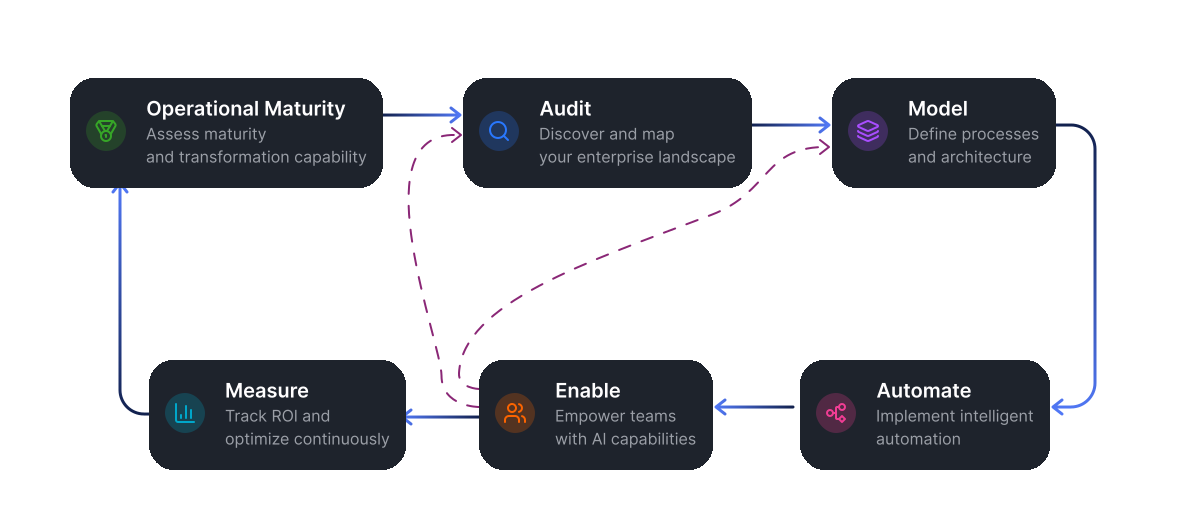
The Four Stages of EAAF Enterprise Transformation Framework
From audit to measurable ROI — a secure, governed, and data-driven transformation cycle
Each stage delivers tangible outcomes, documentation, and ownership clarity
EAAF operates between departments — not inside — ensuring neutrality, compliance, and traceable ROI

Stage 0
Operational Maturity & Readiness Score
EAAF does not start with “fixing processes.”
We first validate whether the organization can absorb and sustain change
Pain Solved
Failed transformation initiatives caused by unclear ownership,
weak governance discipline, and lack of data transparency
Goal
Assess how ready the organization is to absorb and sustain
cross-department change — structurally, culturally,
and technically — before investing in process redesign or automation
Five Readiness Dimensions

Process Ownership
Clarity of roles and decision-making authority
Example Indicators
Defined process owners?
Can they approve changes?

Documentation
& Standards
Level of process and policy formalization
Example Indicators
Are workflows documented
and maintained?

Change Governance
How new rules, systems,
and workflows are adopted
Example Indicators
Is there resistance?
Are decisions respected?

Technical Enablement
Tools and infrastructure
for workflow & automation
Example Indicators
Git discipline, integration platforms,
CI/CD readiness

Data Transparency
& KPIs
Ability to measure performance
and inefficiencies
Example Indicators
Dashboards? SLA monitoring?
Operational metrics?
Maturity Levels
Level 1
Ad-hoc
Processes rely on tribal knowledge; ownership unclear
Stabilize foundation before redesign
Level 2
Documented
but Unmanaged
Processes exist on paper but not enforced
Focus on governance and role clarity first
Level 3
Managed
Processes are followed and measured
Suitable for redesign and automation planning
Level 4
Optimized
Continuous improvement culture in place
High impact automation and orchestration possible
Level 5
Data-Driven & Predictive
Processes evolve based on insights and KPIs
Ready for scaled AI & autonomous workflows
Delivery Attributes

Maturity & Readiness
Scorecard

Transformation
Risk Map

Stakeholder Alignment
Matrix

Recommended Rollout Path
(Realistic & Pacing-Aligned)
Why Stage 0 is Critical
Risk Without Stage 0
No clear process ownership
Low documentation discipline
Resistance to change
Weak infrastructure for automation
Lack of baseline metrics
Impact
Decisions stall; redesign approval takes months
People revert to “how we always did it”
Silent sabotage / slow rollouts
Automations break or become “shadow IT”
ROI becomes subjective → CFO rejects initiatives
How Stage 0 Eliminates It
Establish governance + accountable owners
Define enforceable standards + enable adoption
Identify influencers + build alignment early
Adapt implementation to actual technical maturity
Define measurable KPIs before modeling
In short: Stage 0 ensures that transformation sticks, instead of becoming another abandoned improvement initiative

Corporate Takeaway
“This approach protects our internal teams and budget.
We start by understanding readiness, align expectations, and ensure we aren’t forcing change where the organization is not prepared.”
 Previous Stage
Next Stage 
Stage 1
Audit & Value Mapping
Pain Solved
Lack of visibility, fragmented ownership,
unverified process performance
Goal
Create a fact-based understanding of how processes actually
run across departments, exposing bottlenecks and inefficiencies
without touching production systems
Stage Structure

Objective Definition
Define audit boundaries: target processes, departments,
KPIs, and governance scope

Execution
- Conduct structured interviews and document reviews to capture “as-is” workflows
- Use Business Process Management System to visualize current cross-departmental process flows
- Collect verifiable evidence (artifacts, screenshots, anonymized logs) under NDA and InfoSec policy

Delivery Attributes
- EAAF Audit Report — a verified summary of inefficiencies, ownership gaps, and ROI opportunities
- Business Process Management System “As-Is” Process Model (BPMN) — a visual, auditable representation
- Executive Summary Deck — baseline KPIs, quantified loss areas, and transformation priorities

Compliance note
EAAF audit is non-intrusive — no direct data access, no system integration
Evidence is validated collaboratively with client process owners
Frequently Asked Questions
We’ve paid Deloitte, EY,
or internal teams for process audits before.
Why another one?
Emphasize that EAAF Audit is not another management review — it’s a technical and orchestration-level audit focused on cross-department dependencies and process flow integrity, not financial controls
You say non-intrusive, but how will you collect evidence?
Through interviews?
That’s subjective
State that evidence is based on observable workflows and system exports provided by the client — not manual storytelling. Offer an evidence classification matrix (documents, dashboards, task logs)
Will you store any process data externally?
Clarify: all artifacts remain within client-controlled environments (e.g., Confluence, SharePoint, or internal Git), Exelor only delivers models and reports
Corporate Takeaway
“Good start — but we’ll need strict InfoSec alignment and clear methodology documentation before letting an external party run an audit”
Previous Stage
Next Stage
Stage 2
Process Modeling & Target Design
Pain Solved
Process fragmentation
and unclear accountability
Goal
Define an optimized, transparent “to-be” operating model
with clear governance, measurable KPIs, and version control
Stage Structure
Objective Definition
Align on target outcomes, ownership structure, and governance standards
Execution
- Model optimized workflows in Digital Process Automation Software (BPMN + DMN)
- Version models through Git/CI-CD for full traceability
- Define hand-offs, decision logic, and performance metrics across departments
Delivery Attributes
- Target Operating Model (TOM) — BPMN/DMN models with ownership and KPIs
- RACI Matrix & Governance Checklist
- Simulation Report — projected time and cost improvements
Frequently Asked Questions
Our BPM or Process Excellence office already models workflows
Position EAAF as cross-functional alignment layer — bridging gaps between departmental BPM efforts, not replacing them
We have ARIS / Signavio / IBM BPM — can we import/export?
Prepare connectors or export templates. Say: “Camunda or Operaton models can export to BPMN 2.0 standard, fully compatible with your tools
Who approves the new process design?
Emphasize collaboration — EAAF facilitates design workshops but final approval stays with internal process owners
Corporate Takeaway
“The methodology feels strong — but we’ll expect you to align with our internal architecture and process frameworks”
Previous Stage
Next Stage
Stage 3
Automation & AI Orchestration
Pain Solved
Manual work, disconnected automation pilots,
and lack of orchestration between existing systems
Goal
Implement the designed processes through secure automation, AI agents,
and cross-system orchestration — without creating new vendor lock-in
Stage Structure
Objective Definition
Define automation scope, expected ROI,
and InfoSec boundaries
Execution
- Implement orchestrations with iPaaS (Integration Platform as a Service); execute repetitive tasks via RPA (Robotic Process Automation)
- Use Digital Process Automation Software DMN, low-code for business logic and LangChain, n8n, etc. for intelligent agents
- Secure automation with Vault;
manage deployment and rollback through Git/CI-CD
Delivery Attributes
- Operational Automations — pilots or production workflows
- Implementation Documentation — architecture, compliance, and maintenance guide
Frequently Asked Questions
After you implement, who owns the code, scripts, bots?
Reassure them that ownership and repositories remain under their control, Exelor just configures and hands over through Stage 3.5
We already have MuleSoft / Power Automate / ServiceNow RPA
Highlight that EAAF is integration-agnostic — it orchestrates what they already use, not replaces it
UiPath bots need credentials;
how is that handled?
Show Vault-based credential management and approval process flow; mention that all secrets stay on client infrastructure
Corporate Takeaway
Looks practical — but we need proof that this won’t create a ‘shadow IT’ layer we can’t govern later
Previous Stage
Next Stage
Stage 4
Training & Enablement
Pain Solved
Dependence on external vendors
and lack of internal capability
Goal
Ensure client teams can maintain, evolve,
and extend EAAF solutions independently
Stage Structure
Execution
- Conduct hands-on sessions for business analysts, IT, and operations teams
- Deliver “Run & Scale” manuals covering CI/CD,
model updates, and governance checkpoints
Delivery Attributes
- Knowledge Transfer Workshop Decks
- Operational Guides + Checklists
- Certification of Readiness — client verified
to manage the system autonomously
Frequently Asked Questions
Will our teams really be able to operate this alone?
Offer modular training: strategic (executives), operational (analysts), and technical (IT). Provide sample agenda
What if we need help six months later?
Offer optional support retainer or quarterly health check instead of long contracts — keeps trust while reducing commitment fear
Corporate Takeaway
Good — this reduces risk. If we see real capability transfer,
we’ll trust you faster
Previous Stage
Next Stage
Stage 5
Monitoring, ROI & Continuous Optimization
Pain Solved
Lack of measurable outcomes
and continuous accountability
Goal
EnEstablish live performance visibility, validate ROI,
and feed insights back into modeling and audit stages
Stage Structure
Objective Definition
Define measurable KPIs and governance cadence (monthly/quarterly reviews)
Execution
- Monitor performance via Monitoring and Data Visualization Platforms dashboards
- Use AI Agent modules for AI validation,
bias checks, and explainability - Automate ROI analytics with iPaaS + BI analytics
Delivery Attributes
- Performance Dashboard (live + export)
- ROI Report — financial & operational gains validated with client
- Governance Log — auditable record
of automation and AI decisions
Frequently Asked Questions
You don’t have access to financial data — how do you measure savings?
Reassure them that ownership and repositories remain under their control, Exelor just configures and hands over through Stage 3.5
Who hosts Grafana / BI dashboards?
Highlight that EAAF is integration-agnostic — it orchestrates what they already use, not replaces it
Who triggers the 4→2→1 feedback loop?
Show Vault-based credential management and approval process flow; mention that all secrets stay on client infrastructure
Corporate Takeaway
We like the transparency — but we’ll expect formal governance cycles and alignment with our existing performance management systems
Previous Stage
Next Stage

🔁 Iterative Governance Cycle
- 4 → 2: Performance insights refine process models
- 4 → 1: ROI data reprioritizes new audits and value streams
- Every stage closes with documented deliverables, ensuring traceability, ownership, and measurable impact
💼 How Enterprises Benefit
- Controlled transformation: every action is documented, versioned, and governed
- Neutral orchestration: EAAF operates between departments — minimal interference, maximum coordination
- Proven ROI: measurable metrics at every delivery checkpoint
- Capability transfer: internal teams become self-sufficient post-Stage 3.5
- Compliance-ready: audit trail, access control, and AI ethics built in.
EAAF — Corporate Client Perspective
🧩 Overall Corporate Takeaway
“EAAF looks structured, measurable, and tech-agnostic — it fits our vision of data-driven transformation
But before engagement, we’ll need:
- clear governance and InfoSec compliance documentation,
- proof that our teams remain owners,
- measurable ROI pilot, not just theoretical modeling”
💡 Summary: What Corporates Like vs. What They Fear
With EAAF

Non-intrusive, governed, measurable approach
Vendor-agnostic orchestration
Clear ROI tracking
Training & knowledge transfer
Iterative governance cycle
Without EAAF

Data exposure or compliance breaches
Creation of a parallel “shadow IT” layer
Unverifiable financial assumptions
Dependence on external expertise
Change fatigue and resource strain