
Accuracy is not only important in the world of finance and accounting, but also required. However, the process of translating large amounts of structured documents such as ledgers or balance sheets into a different language has been a long, tedious and error-prone process. Formatting is usually lost in traditional translation tools, whereas human translation is time-consuming and expensive.
eXelor created a Python-based, lightweight AI translator capable of translating complex DOCX accounting documents in English to Simplified Chinese – keeping tables, lists, margins, and styles. Operating fully in Google Colab using GPT-4 and context tagging, it provides fast and fully formatted results in 2 hours at approximately 8 dollars per 5,800 words, offering a reliable, format-safe localization process with no manual editing or additional software.
AI-Powered DOCX Translation, Preserving Layout and Terminology
The problem was obvious: it was necessary to translate multipage DOCX files and preserve the integrity of the layout.
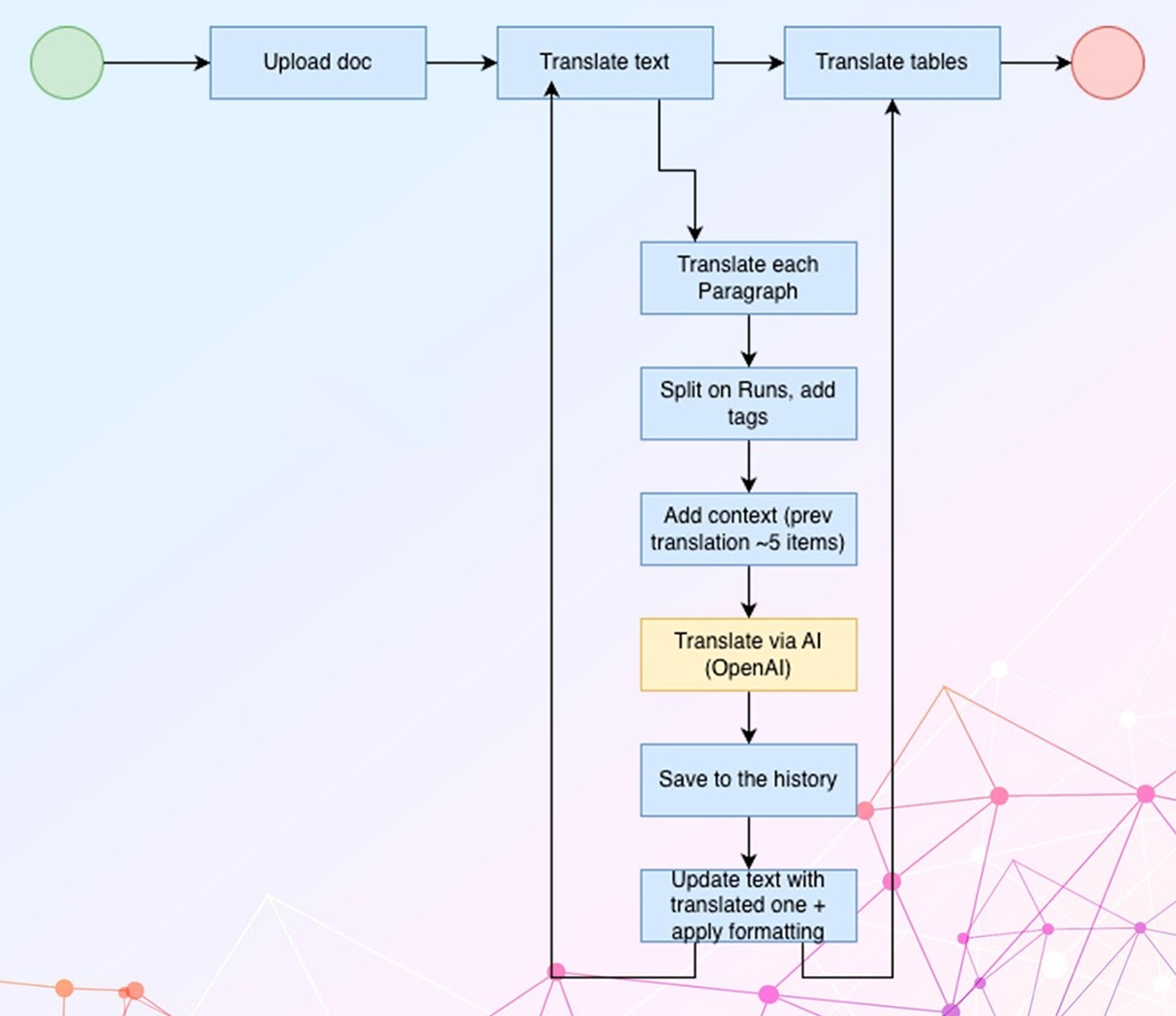
The team developed a Python script that runs on the OpenAI GPT API, which is a Python-based application, and runs directly on Google Colab, without any installation. The script works with each paragraph and table separately, transmits text fragments to the model, and inserts the translations back in the same place without disrupting the structure of the document. Text tagging and context memory were introduced to provide consistency in terminology – enabling the AI to reuse words and be coherent across large files.
Several models were experimented, including GPT-4o, GPT-4, and GPT-5, and GPT-4 was the best in terms of translation quality and speed. The last system automatically generates a translated, well formatted document in the browser.
Fast, Cost-Effective AI Translation
The entire project – from concept to working solution took just 2 hours. At a cost of roughly $8 for 5,800 words, the tool achieved enterprise-level translation quality at a fraction of traditional cost and time.
What once required specialized infrastructure and manual layout adjustments is now a self-contained, repeatable AI workflow. The system delivers consistent translation quality, even for highly technical or tabular accounting data.
Transforming Document Localization with AI
The given project proves that the translation using LLM can be better than the traditional ones – not only linguistically but also visually. It also demonstrates the increasing strength of AI-based document processing: fast installation, low cost and almost human accuracy.
Using this solution, eXelor demonstrated that AI is not only changing the way we write, but also the way we comprehend, localize and reproduce structured knowledge across languages.
What was automated?
- Translation of multipage DOCX accounting documents from English to Simplified Chinese
- Preservation of tables, lists, margins, and styles
- Paragraph- and table-level processing to maintain structure
- Automatic reinsertion of translated text into original layout
- Terminology consistency via text tagging and context memory
- AI model selection (GPT-4) for optimal accuracy and speed
- Cloud-based execution via Google Colab with no installation
- Fully formatted output generated automatically
- Handling of both textual and tabular financial data
- Low-cost, repeatable AI workflow replacing manual translation.
Technologies used
- LLMs: OpenAI GPT-4, GPT-4o, GPT-5 (tested)
- Programming Language: Python
- Libraries: python-docx, openai, tqdm, io, re, json
- Environment: Google Colab (cloud execution, no local setup)
- Data Handling: DOCX parsing, paragraph and table iteration
- Context Optimization: Text tagging, semantic memory for term consistency
- Output Management: DOCX structure preservation, inline style retention
- Performance Metrics: 5,800 words → ~$8 cost, 2 hours total development
- Use Case: AI-powered translation for accounting and financial documents
Ready to boost your productivity?
Let us review your process and show how AI can simplify, speed up, and scale your operations – without hiring more people