

The translation of financial documents is a serious problem: it is necessary to remain accurate and at the same time retain the complicated formatting. Our client, who was in charge of international accounting activities, experienced a bottleneck: it took 40+ hours of manual corrections in Google Translate and DeepL to translate 100-page ledgers. The conventional translation systems distorted financial terms and ruined document format, posing compliance and operational delays.
Our GPT-based Python application saved 20x on translation expenses, preserved 100% formatting accuracy, and provided higher accuracy on specialized financial terms.
The Challenge
Business Impact
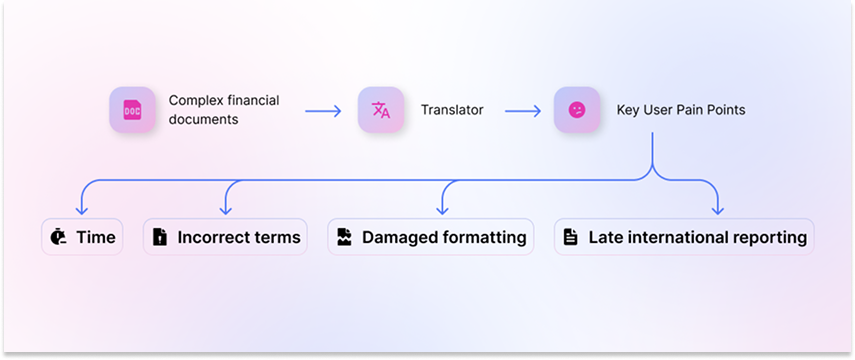
Key pain points:
- Manual corrections of 100-page documents required up to 40 hours using traditional translation services.
- Inaccurate financial terminology created compliance and audit risks.
- Corrupted files that need costly re-creation of documents.
- Late international reporting on business operations.
Key Requirements
- Parse DOCX files efficiently without breaking document structure
- Maintain all formatting (tables, styles, colors, fonts)
- Use the same financial terminology in documents
- Reduce development and deployment time
- Facilitate easy adoption by clients with no technical skills needed.
Solution Evolution: Four Strategic Iterations
Iteration 1: Rapid Proof of Concept
Objective: Validate GPT’s capability to translate while preserving basic structure.
Implementation Approach:
We selected Python and Google Colab to be as fast as possible – from concept to working prototype in 15 minutes.
Core Features Built:
- OpenAI API integration
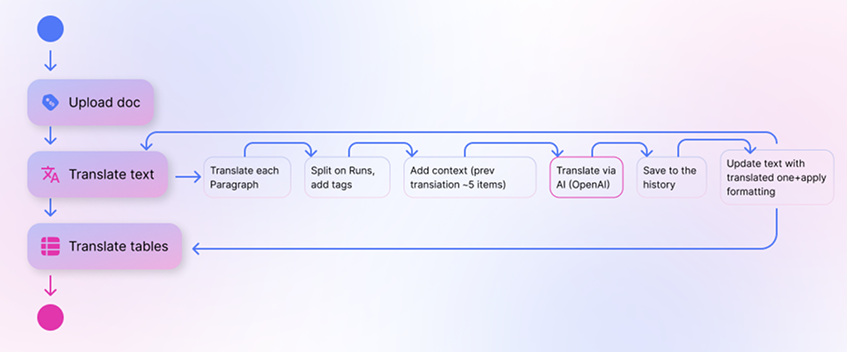
- Processing of paragraph-by-paragraph texts
- Cell-by-cell table handling
- Browser-based file upload with automatic download
- Text replacement, preserving document structure
Testing Environment:
- Model: GPT-4o-mini
- Sample: Limited text volume
Issues Discovered:
- Loss of text formatting (bold, italic, underline)
- Table cells of multiple paragraphs losing content.
Iteration 2: Resolving the Formatting Issue
The Context Loss Problem
The analysis showed that the script was divided into fragmented paragraphs according to the change of style. Example:
Original: “This is a simple technical example”
Translated as 3 separate chunks:
- “This is a simple”
- “technical”
- “example”
Critical Business Impact:
- Contextual meaning lost resulting in wrong translations
- High API prices due to overutilization
- Grammatical errors in languages with cases (Russian, German, Polish)
- Context buffer waste on fragments instead of meaningful translation history
Solution: XML-Style Text Tagging System
We used semantic tags to format and designed prompts to explicitly manage tagged content structure.
Results:
- Formatting was maintained with complex table headers
- Proper grammar rules that are upheld in formatted text.
Business Value: Removed manual reformatting work, which saved 15-20 hours per document.
Iteration 3: Context-Sensitive Translation Quality
The Terminology Consistency Problem
Checks on quality showed that the word issue was translated inconsistently throughout the same document-in some cases as problem, in some cases as share issuance, in some cases as publication.
Root Cause: GPT did not have enough context to comprehend patterns of document-wide terminology.
Solution: Rolling Context Window
We implemented a 5-translation context window, passing both source and target text to each request.
Quick Strategy of Engineering:
- Demonstrate to GPT how it has translated similar words in the past.
- Give context of the adjacent sentences.
- Allow standardized terminology throughout the document.
Results:
- Use of uniform financial terminology in documents.
- Better single-word translations (important to table headers)
- Reduced client review time by 70%.
Business Impact: $0 spent on post-translation terminology corrections.
Iteration 4: Model Optimization and Cost Reduction
Models Tested:
- GPT-4o
- GPT-4
- GPT-5 (reasoning model)
- GPT-4.1
Test Parameters:
Document: 6,000 words, 35,000 characters
Target: Multiple languages to be verified.
Performance Comparison:

Concluding remarks:
| Model | Speed | Quality | Cost per 6K Words | Best For |
| GPT-5 | Very Slow (reasoning overhead) | Excellent | ~$8.00 | Not recommended |
| GPT-4 | Moderate | Excellent | ~$2.00 | Legacy projects |
| GPT-4o | Fast | Very Good | ~$1.20 | Quick translations |
| GPT-4.1 | Fastest | Excellent | $0.30 | Production use |
Key Findings:
- Do not use reasoning models to do translation tasks-huge computational costs and no quality improvement.
- Reduced temperature (0.3-0.5) enhances literal accuracy of financial documents.
- GPT-4.1 provided 20x cost savings over original estimates- $0.30 vs. $6.00 as projected by pricing page.
- Speed of processing is important- GPT-4.1 was able to translate 6,000 words in less than 3 minutes.
Production Deployment: Handling Scale
Challenge: Translate 30-page document (6,000 words) in single session.
Rate Limit Issue Hit at 15% Completion:
Error code: 429 – Rate limit reached for gpt-4
TPM: Limit 10000, Used 9154, Requested 847
Solution: Intelligent Retry Logic
# Exponential backoff with 5 retry attempts
for attempt in range(5):
try:
response = openai.chat.completions.create(…)
break
except RateLimitError:
time.sleep(5 * (attempt + 1))
Results:
- Zero failed translations across multiple rate limit hits
- Complete document processed automatically
- Unattended operation possible for large batches
Final Implementation: Business Results
What We Delivered
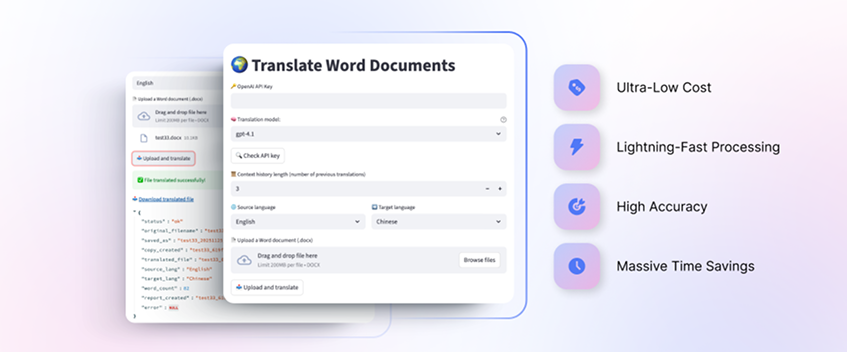
An enterprise DOCX translation Python script that is production-ready and runs on Google Colab – no installation, no infrastructure, deploy instantly.
Project Metrics
| Metric | Result / ROI |
| Cost per 6,000 words | $0.30-0.40 USD (GPT-4.1 model) |
| Processing Time | < 1 min |
| Accuracy | High quality |
| Client Savings | Automated solution: 2h implementation + 20min debugging vs traditional manual translation |
Supported Formatting Features
Currently Supported:
- Text styles (italic, bold, font size, font family)
- Font and background colors
- Superscript/subscript (critical for footnotes)
- Page breaks and section breaks
- Table cell shading and borders
- Images outside paragraphs
- Bullet points and numbered lists.
Roadmap for Enhancement:
- Images within paragraph flow
- Hyperlinks (DOCX stores these in multiple formats)
- Advanced table features (merged cells, nested tables)
- Document-wide terminology dictionary for guaranteed consistency
- PDF export with formatting preservation
Technical Implementation Notes
Best Practices for Developers
Rate Limit Management:
- Implement exponential back off, not fixed delays
- Monitor token usage per request
- Consider batch processing for large documents.
Context Optimization:
- Include both source and target text in context window
- Limit to 5-7 most recent translations (cost optimization)
- Clear context between unrelated documents.
Model Selection:
- Test empirically with pricing pages don’t reflect real-world costs
- Avoid reasoning models for deterministic tasks
- Monitor model updates (GPT-4.1 was a game-changer)
From Concept to Production
This project reinforced critical principles for LLM-powered automation in business contexts:
Rapid Prototyping Wins
15 minutes to proof-of-concept meant we could validate the approach before significant investment. Google Colab eliminated infrastructure setup time entirely.
Iterative Problem-Solving
Each iteration solved a specific issue revealed by real-world testing. Perfection isn’t the goal—shipping working solutions quickly, then improving them, is.
Model Selection is Critical
Don’t trust pricing pages. GPT-4.1 was 20x cheaper than expected and faster than alternatives. Always test empirically.
Context Engineering Matters
The difference between mediocre and excellent translation wasn’t the model—it was how we structured context. The 5-translation window was the breakthrough.
LLMs Accelerate Development
GPT assisted not just with translation, but with writing the Python code itself. Total development time: 2 hours, despite not having touched DOCX libraries in 10 years.
Ready to Transform Your Document Processing?
This case study demonstrates how targeted LLM engineering solves complex business problems while delivering measurable cost savings and quality improvements.
Our team specializes in building custom solutions for financial, legal, and technical document automation. Whether you’re dealing with translations, data extraction, or document generation, we can help you:
- Reduce operational costs by 80-95%
- Eliminate manual correction workflows
- Accelerate operations
- Ensure compliance and consistency.
Contact us today for a free consultation and discover exactly how much time and money we can save your company with intelligent automation.
FAQ
What’s the cost per page for DOCX translation?
Approximately $0.06-0.08 per page (assuming ~200 words/page with GPT-4.1). Compare this to $2-5/page for human translation services.
Can you translate PDF files?
Yes, but DOCX is simpler because it’s XML-based. PDFs require additional parsing (PyPDF2 or PDFPlumber) and may lose formatting. We recommend converting PDFs to DOCX first.
How long does translation take?
3–5 minutes for 6,000 words with GPT-4.1, including API calls and rate limit handling. Traditional services take 24–48 hours.
What languages are supported?
All languages GPT supports. We’ve tested extensively with English↔Chinese, English↔Russian, and English↔German for financial documents.
Is formatting 100% preserved?
Yes for core formatting (fonts, styles, tables, colors). Advanced features like merged table cells or inline images may require custom handling.
Can you handle specialized terminology?
Absolutely. The context window approach ensures consistent terminology. We can also integrate custom glossaries for industry-specific terms.
